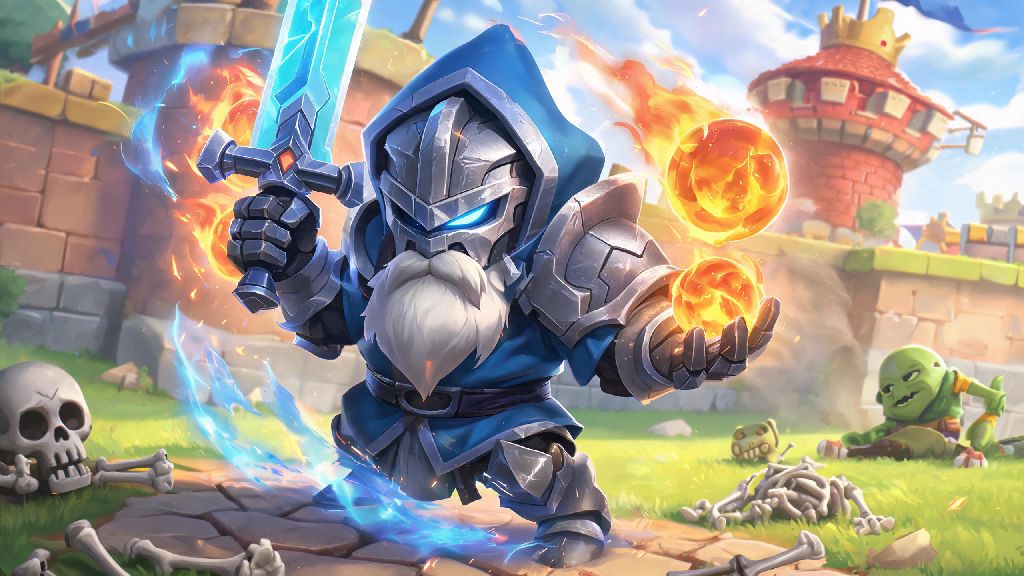
If you've ever sat in a Clash Royale match wondering why your opponent's pushes feel unbreakable even with the same elixir cost, you've probably seen merge tactics in action without knowing it. If you're asking what is merge tactics clash royale, you're in the right place to learn a trick that can take you from mid-ladder stuck to consistent trophy gains, no fancy new cards required. I've been playing Clash Royale since global launch, and I started using merge tactics two years ago to climb from 4k to 7.8k trophies without spending a dime on the game. I still remember the first time I faced a properly merged P.E.K.K.A and Wizard push as a mid-ladder player: I spent all my elixir trying to stop the P.E.K.K.A, and the Wizard wiped my entire defense before I knew what hit me.
What is Merge Tactics in Clash Royale, Exactly?
At its core, merge tactics are when you pair two complementary units close enough together that they work as a single unbreakable force, instead of being picked off one by one. It's not just dropping two cards at the same time, it's timing their placement so their defensive and offensive strengths overlap perfectly. For example, dropping a P.E.K.K.A right behind a Wizard so the Wizard melts swarms that would otherwise take down the P.E.K.K.A quickly, while the P.E.K.K.A tanks all incoming damage for the Wizard. The key that makes merge tactics work so well is that it eliminates the individual weaknesses of each unit you use, so you get way more offensive or defensive value than you would if you used each card separately. A lot of new players make the mistake of dropping units spread out across the lane, which gives opponents an easy chance to counter each one separately for a positive elixir trade. Merge tactics eliminate that risk by making your push work as a single unit, so your opponent has to spend more elixir to counter than you spent to build the push.
Core Rules for Using Merge Tactics Effectively
You don't have to be a top 10k player to pull off merge tactics consistently, but you do need to follow a few simple rules to avoid wasting elixir or making yourself vulnerable to counter pushes. Even small missteps in placement or timing can turn a winning merge into a massive elixir loss, so these rules are worth memorizing before you test the tactic in ranked matches. I used to ignore most of these rules when I first started, and I lost more matches than I won until I adjusted my playstyle.
I used to make the mistake of dropping units right on top of each other all the time, and I lost so many matches to opponents landing a perfect Fireball on my merged Giant and Wizard. Once I started leaving a small gap between them, I cut my spell-related elixir losses by almost 60% in just a week. It's such a small adjustment, but it makes a massive difference in how reliable your merged pushes are.
Pros and Cons of Relying on Merge Tactics
No tactic is perfect for every scenario, and merge tactics have clear downsides you need to know before you use them in every match. Most players who are new to merge tactics worry that they'll be too predictable, but you can mix up your merge combinations every match to keep opponents guessing. It's still important to know when to use merge tactics and when to stick to faster cycle plays instead.
On the plus side, you get far more value per elixir spent than you would from dropping individual units, because your units cover each other's weaknesses so they last longer on the field. Merged pushes also force opponents to make quick, high-pressure decisions, and most mid-ladder players will panic and spend too much elixir trying to counter, leaving them open for your follow-up push. Another big pro is that merge tactics work with almost any deck archetype, from beatdown to cycle, as long as you have at least one tank and one support unit in your deck. If you're a fan of beatdown decks, merge tactics will feel like a superpower, since you're already used to building slow, powerful pushes down a single lane.
On the downside, merge tactics are slower to set up than quick cycle pushes, so they're not ideal if you're running a full cycle deck that relies on fast, frequent attacks. They also leave you temporarily vulnerable to opposite lane pushes while you're building your merge, especially if you spend more than 6 elixir on the initial push. Finally, if you misjudge your opponent's counter cards, you can lose your entire merged push for a massive negative elixir trade that can lose you the match in one go. I only use merge tactics in the first two minutes of a match if I know my opponent's deck doesn't have heavy spell damage or fast opposite lane counters. If I see they have a Rocket or a Goblin Barrel, I hold off on big merged pushes until double elixir time when I can spare extra elixir for counterplay.
Common Merge Tactics Mistakes to Avoid
Even players who understand how merge tactics work often make simple mistakes that turn a winning push into a losing one. Most of these mistakes come from rushing your push or not scouting your opponent's deck first, and they're easy to fix with a little practice. I've made every single one of these mistakes at least a dozen times, so I know exactly how costly they can be.
The most common mistake is overspending on a single merge. I see players drop a Giant, Wizard, and Mini P.E.K.K.A all in one push, spending 12 elixir at once, leaving them with zero to defend a Hog Rider drop on the other lane. You should never spend more than 7 elixir on an initial merged push before double elixir. Second mistake is merging units that have conflicting roles. For example, merging a Miner with a Giant is almost always a waste, because the Miner is meant to go behind enemy towers while the Giant moves slowly down the lane, so they split almost immediately.
Third mistake is forgetting to adjust your merge for the current game phase. In single elixir, small merges like Hog Rider + Fire Spirits work great, but in triple elixir, you can go for bigger merges like Golem + Electro Dragon + Wizard that are almost impossible to counter. Another mistake I see all the time is not scouting your opponent's deck before using a big merge. If you drop a merged Balloon push before you know your opponent has an Inferno Tower, you're just throwing elixir away. Always spend the first minute of the match testing their counters before you commit to any large merged pushes.
At the end of the day, learning what is merge tactics clash royale and how to use it correctly is one of the fastest ways to climb the trophy ladder without switching up your favorite deck. You don't need any legendary cards or thousands of dollars spent on upgrades to make it work, just a little practice with timing and placement. Start small with 4-5 elixir merges in casual matches first, so you can get used to the timing before you use them in ranked play. Before you know it, you'll be building pushes that your opponents have no idea how to counter, and your win rate will jump faster than you expect.